


The Challenge
Move quickly with confidence
Pella, an Iowa-based and family-owned company founded in 1925, has a long history of designing and manufacturing beautiful custom doors and windows. But moving the sales process of these thoughtful pieces online proved to be difficult — products were highly configurable, with nuanced pricing, configuration rules, and a blend of digital and in-person steps.
Yet they had only one internal UX designer to support multiple teams. Engineering was waiting on designs. Stakeholders were waiting on “proof” that UX decisions would work. And the e-commerce team had been looking at the same flows for so long that it was hard to see what wasn’t working anymore. The team was stuck in a familiar pattern: a small internal UX function, a long backlog, and a lot of opinions—without the research, capacity, or design operations rigor to move quickly with confidence.
The result: UX was perceived as a bottleneck in the product development pipeline, and strategic questions about the long-term omni-channel experience fell into the backlog abyss.
The Work
Here’s how we helped Pella
What started as a review of their current experience, conducting a heuristic analysis across the customer journey, quickly shifted into our team entering as an embedded set of UX design partners focused on design operations and delivery: increasing throughput, improving UX quality, alleviating pressure, and building a foundation for strategic data-driven decision-making.
Key activities:
Prioritized a UX backlog aligned with product strategy and engineering capacity.
Introduced user research and usability testing as a repeatable practice.
Helped product leaders socialize UX recommendations with stakeholders.
Advised on long-term UX hiring needs and design maturity considerations.
Co-created “North Star” and next-generation omni-channel concepts, including AI-visualization experiences.
Refreshing the experience with a new set of eyes
Because we weren’t tied to the original implementation, we could approach the experience with curiosity and an unbiased, expert lens.
Accessibility
Provided site wide recommendations on approaching a fully AAA accessible website and design system. Not just meeting, but exceeding standards.
Consistency
Simplified copy, CTAs and decision points for customers configuring a complex product. Creating an experience that emphasized similar layouts and systems.
Pattern
Highlighted opportunity areas and the importance of the creation of a design system or pattern library, helping create a cohesive user experience.
Journeys
Identified friction in the end-to-end buying journey, especially on mobile, a much less common mode of browsing for current customers.
UX Heuristics
Measured compliance of their current experience against the 10 UX Heuristics, and turned these into tangible UX recommendations.
Interaction
Identified areas for enhanced interaction touch-points. Like animating navigational elements showing product operation, reinforcing complex industry terminology.
Our role was equal parts UX design and strategic mirror: we reflected back patterns that had become invisible to the team over time and re-framed them in terms of customer trust, effort, and clarity. This fresh lens is one of the most powerful benefits of an embedded design team derived from a third-party.
Scaling from one designer to a functioning UX team
From our initial findings, we created a roadmap that prioritized the work to be done. We then teamed up with the single in-house designer to collaborate with product and engineering leadership and define where UX capacity would have the greatest impact.
Over time, we became a hiring partner. We developed interview protocols, co-facilitated conversations with candidates, and reviewed portfolios with an eye toward real-world problem-solving, not just polished screens. Throughout the process, we acted as a sounding board for leaders as they weighed strengths, gaps, and long-term team fit. Our emphasis was on finding talent that are “Humble, Hungry, and Smart”, a concept championed in Patrick Lencioni’s book, “The Ideal Team Player”. The result was hiring two new full-time designers—tripling the size of the internal UX team—both of whom continue to thrive and elevate the organization’s design maturity today.
The UX team grew from one to five designers at its peak, a blend of (newly hired) internal designers and Visual Logic, each aligned to key parts of the business. This shifted UX from a single-point bottleneck to a distributed, coordinated team with shared patterns and collaboration rituals. It also created room for deeper UX work—rather than constant firefighting.
This is when design operations became essential: shared templates, design reviews, collaborative problem solving and predictable ceremonies gave the team a common standard of quality without slowing them down.
“[Visual Logic] was an extension of our team— There have not been many 3P solutions I have worked with that I cared for as deeply as my team. They engaged, brought ideas, and were just as passionate as our FTE.”
Read full review Rebecca Hicks Director of Digital Transformation, previously E-Commerce Product Manager
Bringing structure to UX research and validation
Before our engagement, user research was ad-hoc and most often skipped due to time pressure and a lack of resources. There wasn’t an emphasis on “evidence-based decision making”, as such there was no repeatable way to generate it.
We helped the team:
Stand up usability testing for high-risk flows
Integrate and conduct concept validation early in the design cycle
Create simple, reusable research plans, protocols, and discussion guides
Translate research findingsinto stakeholder-ready narratives and visuals
Champion long-term customer researchto support business initiatives
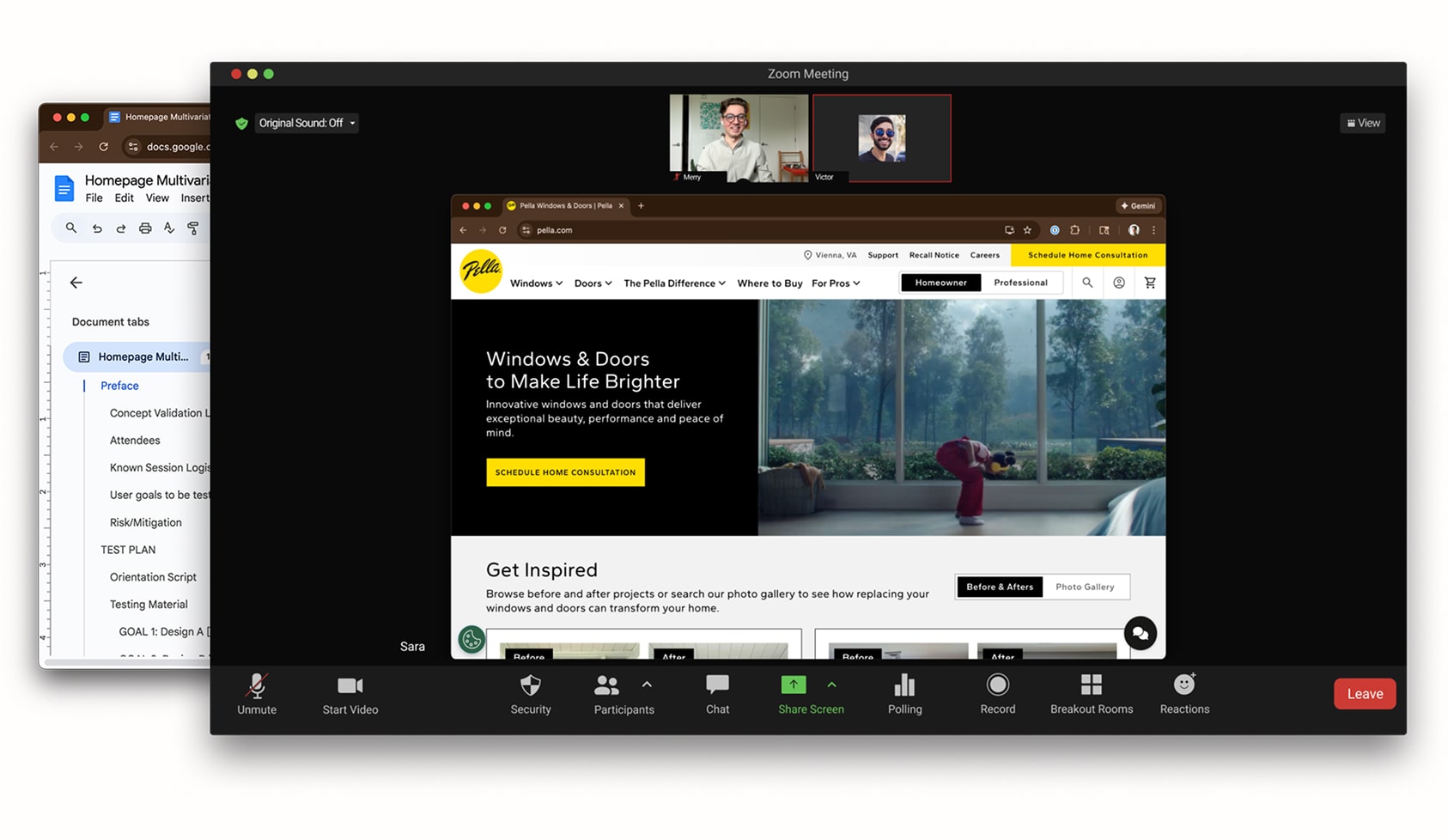
Over time, stakeholders didn’t just accept research—they started asking for it. Product managers and leaders began requesting user validation as a standard input into decisions, using findings to make the case for design directions with executives and cross-functional partners.
This shift elevated UX research from a “nice to have” to a core part of product strategy, outside of analytics support.
Supporting delivery, scaling maturity, and shaping key initiatives
Throughout our 2-year engagement, our role expanded and we stepped into several adjacent responsibilities that strengthened delivery quality and long-term UX capability across the organization.
Joined in refinement sessions and QA activities to ensure design intent carried through to production.
Co-created “North Star” and next-generation omni-channel concepts, including AI-visualization experiences.
Led foundational UX initiatives from inception to production—including a full site navigation redesign, key marketing initiatives and deep funnel research—to improve clarity across the end-to-end experience.
Helped create a strategy for the full-site redesign for a recent acquisition, CWS, creating a new navigation model and a strategy for future acquisition support with a white-label component set to streamline future acquisitions.
Supporting the consolidation of Pella branch partner sites into Pella.com. This included designing for the implications of global and secondary navigational elements, as well as interaction design.
Creating a user-driven and intuitive decision path for customers and establishing a foundation that their newly hired designer (whom we helped hire) successfully carried forward.
These efforts represent only a portion of the work completed over our engagement. The scope and pace of activity reached far beyond what a single case study can fully capture, reinforcing how deeply integrated our team became in moving both the product and the organization’s UX maturity forward.
“VL is a delight to work with— based on your teams preference, they will incorporate themselves into existing processes or own stand-alone. Communication is a strong suite— never once did team go over hours or budget; there were times we approached our limit but transparency was key.”
Read full reviewRebecca Hicks Director of Digital Transformation, previously E-Commerce Product Manager
Why an external perspective can change everything
For executives and product leaders wrestling with similar challenges, three reflections stand out:
Scaling Design
It’s not as simple as headcount. It’s about the design operations, rituals, and shared standards that let multiple designers work coherently and collaboratively with engineering.
Finding Blind spots
Fresh eyes expose blind spots. A fresh set of eyes can re-frame the problem in ways your customers already feel—but your org can’t yet see.
Data Led Decisions
You don’t need a full analytics stack to start validating assumptions. Simple, well-structured research and usability testing can shift the quality of every conversation, even without perfect data.
The Impact
UX shifted from a bottleneck to a catalyst
Internally, they moved from one designer to a functioning, embedded UX team with shared practices and a growing team of UX practitioners. Work flowed more smoothly into engineering. Backlogs became more intentional and less reactive. Product and engineering leads had a clearer sense of where UX should be involved—and why.
Culturally, UX research became a respected input rather than an optional extra. Teams started to ask for user validation, not resist it. Leaders used research insights to tell a more credible story about why experience changes were necessary, especially when trade-offs were involved.
Perhaps most telling, the relationship evolved from “outsourced UX support” to trusted advisor. The team invited us into conversations about omni-channel strategy, AI-assisted experiences, and long-range product direction. That shift—from tactical execution to strategic partnership—is itself a key marker of higher design maturity.


