

The Challenge
How do you responsibly monetize ads without damaging the passenger experience?
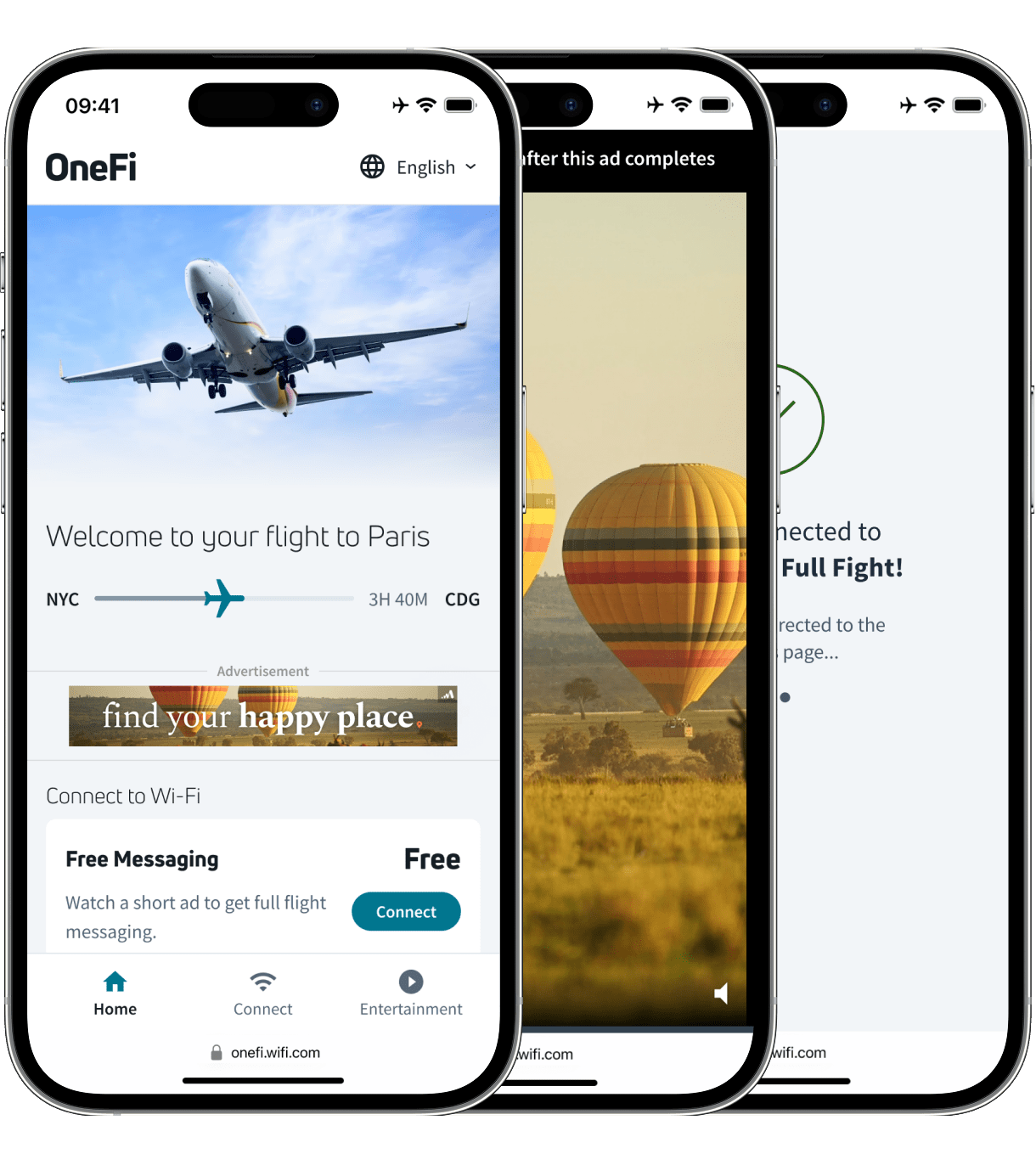
Among Viasat’s numerous connectivity offerings, they provide high-speed in-flight Wi-Fi for more than 60 airlines worldwide. As passengers increasingly expect free internet access, airlines are under pressure to offset connectivity costs. Viasat saw an opportunity: build an advertising ecosystem that delivers real value for advertisers without compromising the passenger experience.
Advertising is a delicate balance. Aligning what advertisers want, what airlines need, what passengers tolerate, and how Viasat can provide it from a technical standpoint is anything but simple. And unlike a mobile app or website, an aircraft cabin is a context where attention is fragmented, intermittent, and unpredictable.
To build ad units and subsequent user journeys that could scale across airline partners, Viasat needed a clearer product strategy, grounded in research, and a design approach that aligned multiple teams around a shared, user-centered vision.
The Work
Here’s how we helped Viasat Ads
We spent a year partnering with product, engineering, sales, and leadership teams to build the foundation for Viasat’s in-flight advertising platform. Our work combined product strategy, human-centered design, and deep cross-functional alignment.
User Research
Performed and synthesized user, market, and competitive research to uncover opportunity areas and inform product strategy.
Design & Prototyping
Designed and prototyped new ad unit concepts and end-to-end user journeys
Concept Validation
Planned and executed concept validation and unmoderated usability studies, measuring outcomes against defined success criteria
Framework
Created strategic frameworks that helped Viasat decide what to build now and what to explore long-term
Alignment
Aligned product, sales, engineering, and ad operations teams around a shared strategy
Workshops
Facilitated workshops across teams to prioritize features and product direction
Understanding the real constraints of attention
We came into the project with an initial hypothesis that passengers were a “captive audience”, meaning they had no other internet access options. Through research and concept testing, we helped teams shift from the idea of “guaranteed attention” to a more realistic view of “earned relevance.” There’s a lot of other context to consider, passengers may glance away at any moment — even in a ‘captive environment’. This mindset became a foundation for how ad surfaces, placements, and formats should behave inside the in-flight portal.
An ad must feel useful, not intrusive. When relevance rises, engagement follows.
Designing for 4 different stakeholders at once
Our recommendations around ad units and user flows had to serve four groups with competing goals:
Airlines — want non-disruptive experiences that maintain brand trust.
Viasat — needs formats that are technically feasible across fleets and portals.
Advertisers — want measurable impressions, targeting, and clarity of placement.
Passengers — want to get online quickly — without friction or irrelevant content.
A shift from bespoke ad units to a modular, scalable system
As we mapped the full ecosystem of advertisers, airlines, and passenger needs, a pattern emerged: bespoke ad units were slowing Viasat down. Each one-off journey created additional design debt, engineering overhead, and inconsistent experiences across airline portals.
We recommended moving toward a modular system of ad formats and user journeys—configurable components built on validated research and repeatable logic. This approach gave Viasat a foundation that could flex to airline branding and advertiser demands without reinventing the experience each time.
| closeAway from… | checkTowards… |
|---|---|
| chess_knightBespoke Time intensive and laborious | view_moduleModular Efficient, scalable and validated |
| filter_1One-off Ad UnitsCompletely unique for each scenario | tenancyStandardized Ad Offerings Configurable to customer request |
| snowingEngineering OverheadChasing down tech debt | dry_cleaningEngineering MaintenanceFixes in one Ad, feed to others |
| hand_mealWhite Glove ServiceSlow, manual, yet personal | lock_openStandardized & Accessible UnitsAligned to advertiser expectations |
| repeatQuick Win MentalityShort-term commodity Ads | tacticStrategic MentalityHow does this new Ad fit into our future strategy? |
Cross-functional alignment that moved the product forward
Viasat’s advertising initiative touched nearly every part of the organization. We partnered closely with:
Product — to define the strategic roadmap
Design — to prototype and validate early concepts
Sales — to understand value propositions for advertisers
Engineering — to ground ideas in reality
Leadership —to establish vision and communication clarity
This alignment work accelerated decision-making and helped stakeholders understand how the product could evolve over time.
The Impact
A foundation for an emerging advertising business
Viasat now has a clearer strategy and a suite of validated product concepts designed to support more than 50 million passengers connected monthly across more than 300,000 flights — while preserving the trust and experience of the traveler.
Our work helped Viasat:
Establish a shared vision for in-flight ad experiences
Align teams on what to build now vs. what belongs in future exploration
Accelerate early implementation of tactical ad products
Lay the groundwork for long-term differentiation in a fast-moving industry
As Viasat continues expanding the One-Fi advertising ecosystem, the strategy, models, and prototypes created through this partnership continue to guide decision-making across teams.

