


The Challenge
Create unity in an industry convinced it needs exception
How do you scale a passenger Wi-Fi portal when every airline believes they’re one-of-a-kind?Viasat is a global communications company that delivers high-speed satellite connectivity to airlines, governments, and commercial markets. OneFi is their platform that brings Wi-Fi, entertainment, and onboard services together in a single passenger experience. OneFi powers in-flight Wi-Fi for more than 60 airlines, from global to regional airlines. Each airline needs a portal that reflects its brand identity, supports its business model, and meets rising passenger expectations for seamless connectivity.
But the existing approach—dozens of bespoke, from-scratch portal builds—created unnecessary complexity. Engineering teams were maintaining a growing list of one-off implementations. Product decisions became harder to scale. Airlines consistently asked for more customization, especially as they expand across regions.
The business question underneath was straightforward:
Could Viasat serve the needs of dozens of divergent airline brands without building each experience from scratch?
The Work
Here’s how we helped Viasat rethink the One-Fi experience
We worked as an embedded strategic partner to bring clarity to the product vision, define the right guardrails for customization, and translate user experience goals into a scalable, airline-ready design framework.
Key activities:
- Conducted market research and competitive bench-marking
- Analyzed airline brand strategies, passenger expectations, and monetization models
- Built a product framework for modular customization
- Facilitated internal alignment sessions with product, engineering, and design leaders
- Defined rules for brand expression that balanced autonomy with operational simplicity
“This project required balancing high passenger expectations with the critical business needs of an airline. At 30,000 feet, user context changes completely. It was an incredible challenge, full of exciting opportunities where design thinking could re-shape the passenger experience.”
 Amadeus Cameron UX Designer @ Visual Logic
What we learned from our research and analysis
Airlines differentiate in tone, services, and loyalty strategies. Their portal must reflect their identity.
Left unchecked, one-off portal implementations balloon into long-term maintenance risk. We reframed customization as configuration—predictable, repeatable, governed.
Expectations shaped by retail and streaming platforms influence tolerance for friction in captive portals.
The design framework
We delivered a flexible design framework and product strategy that balances constraint with choice. Defining the right guardrails for customization, and translate customer goals into a scalable, airline-ready design solutions.
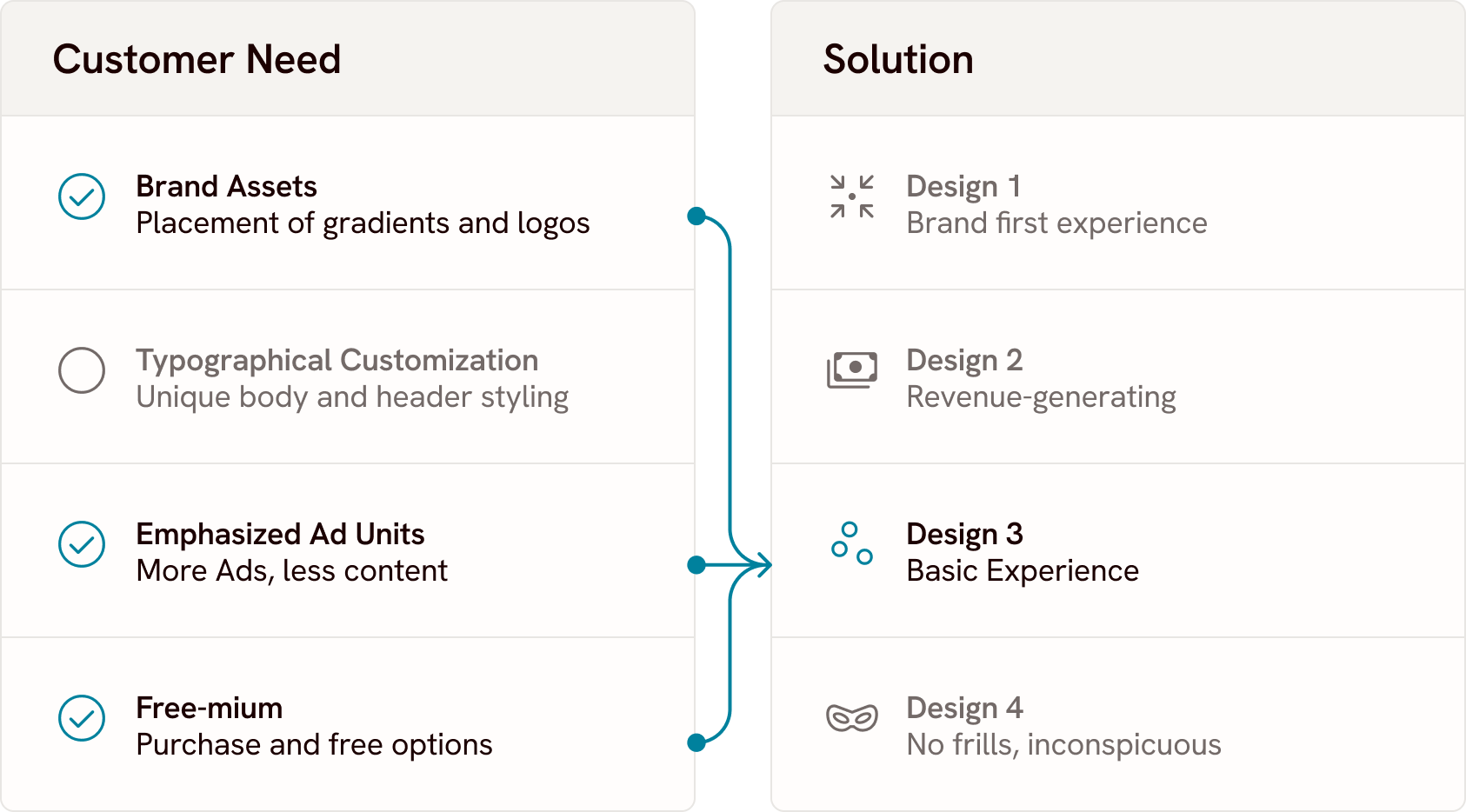
Configuration with guidelines, not customization
We encouraged a change in framework, leading by example with a best-in-class strategy for prioritizing customers, without leaving Viasat to pick up the pieces. To meet the needs of every customer, our framework had three core principles:
Configurable page templates
Layouts adaptable to different content needs, languages, strategies, and brand customization.
Standardized user journeys
Whether it was connection or purchases, we created a pattern library for Wi-Fi flow consistency.
Rules for premium experiences
Guidance for how airlines can introduce loyalty, upsell, or sponsorship elements while still protecting core UX patterns.
The Impact
A scalable product strategy that positions Viasat as the most flexible, most strategic Wi-Fi partner.
By shifting Viasat from custom builds to a clear, modular design system, their teams gained:
Reduced engineering burden — fewer bespoke portals, more repeatable patterns
Stronger alignment across product, design, and engineering — a shared framework for decision-making
A more consistent, high-quality passenger experience — one that still respects each airline’s brand
A future-ready platform for rising expectations around free in-flight Wi-Fi and bandwidth-intensive behaviors like streaming and real-time messaging
In an industry where consumer expectations evolve quickly and airline brands reinvent themselves often, Viasat now has a Wi-Fi portal strategy that can adapt without starting from zero each time.


