The gap new designers must bridge
UX design is not about what you like. It’s about what works best for the end user.
At Visual Logic, some of our new designers walk off the graduation stage and straight into our office. These talented artists are technically sound in their design technique; they understand hierarchy, have top-notch typography skills and are proficient in design software. But from the beginning—coloring books at age three to the final project in their Publication Design course—these artists have been creating designs based on personal preference and “wow factor.”
When artistic instincts get in the way
This is a major hurdle when it comes to newly hired UX designers. They gravitate toward design solutions they like, rather than solutions that will help the end user. Instead of channeling empathy into their designs and thinking about how someone would use the product, they spend the majority of their time in the last phase: high fidelity design, choosing visual appeal over functionality. Buying artwork for someone else is risky business because your tastes are not the same as theirs. The same applies to UX work, it’s risky (and irresponsible) to guess that the end user will like what you like.
Introducing a mindset shift: The Martini Diagram
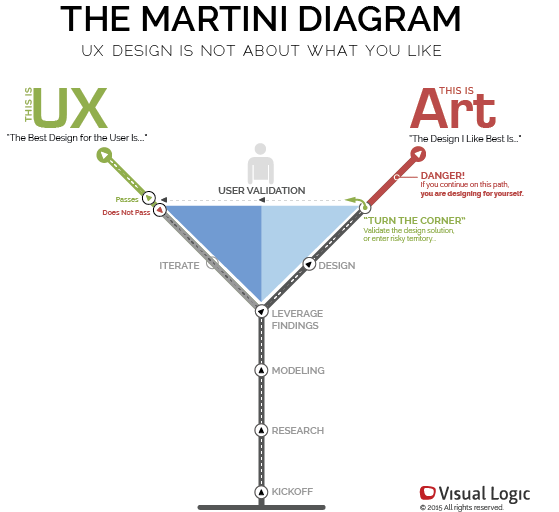
Here’s how it works:
- All projects should start with user research, as this gives us our foundation, and the “stem” of our martini glass.
- As we begin the design phase of the project, we start down the path of innovative solutions (the right side of the diagram). This is perfectly normal and encouraged—at this point we want to hear crazy, brilliant, and unexpected ideas.
- Mid-way through the design phase, we ‘turn the corner’ and move from ideating crazy, unexpected solutions to creating goal-centric solutions that incorporate user and system requirements. This includes validating ideas with real users.
- Because design is an iterative process, it might take a few more “martinis” before it’s just right, but this is where things are refined and perfected. And who doesn’t like a few martinis?
Five questions that foster real UX thinking
So how can we educate new designers about this process? We’ve come up with five questions that help reveal the critical thinking that should be behind every successful solution:
- Is this the right design solution for our end users? Explain how we have achieved a design that meets their needs.
- How did we arrive at this design solution? During the research phase did we hear something from our users that put us on this path?
- When we showed this design to users, what did they say? Did they find it useful, usable and desirable?
- If the design didn’t pass usability testing, what feedback did we get from users and how will we leverage that information in our next design iteration?
- Are there design elements that can be simplified based on our users’ feedback?
The heart of the message
Asking these important questions of your UX designer will help determine whether they have created a piece of art or a meaningful user experience.