

The Challenge
Adapt to a digital world
Compassion International has spent decades changing the lives of children trapped in extreme poverty by connecting supporters with kids through sponsorships that provide education, healthcare, and hope. Historically, they have relied on distributing paper sponsorship forms at events to potential donors. While this has served them well, it has some clear downsides: paper forms are too manual, handwriting is often illegible, and forms include sensitive data.
Recognizing the need to evolve in a digital-first world, they partnered with us to conduct an in-depth exploration of their customer journey. Together, we sought to identify modern, more engaging ways to connect with donors—blending the tactile, in-person experience with seamless digital touch points. The goal was to create a cohesive, intuitive journey that not only strengthens donor engagement but also amplifies the impact of Compassion’s work in communities around the world.
The Work
Here’s how we helped Compassion International
Key UX activities:
- User Research
- Journey Mapping
- CX Design
- UX Design
- Concept Validation
- Personas
- Interaction Design
- Motion Design
- Content Strategy
- UI Design
- North Star Vision
Compassion had events down to an art form—trained volunteers, perfectly arranged tables, and speakers who could move a crowd. They’d tried to modernize the experience with Text to Sponsor, QR codes, and a Sponsor Now app, but none of it quite clicked. Yet they couldn’t afford to give up; events were the heart of their sponsorship program, generating the majority of their donor commitments.
We began by getting to know the concert-goer—primarily Christian women, ages 30 to 50—and mapped her entire journey. From the moment she purchased her ticket to weeks after the concert ended, we studied her thought process, looking for ways to make the experience smoother and boost long-term sponsorship retention. Stakeholders shared that while concerts were a major driver of new sponsorships, they also had the lowest retention rate. Since most attendees didn’t come with the intent to sponsor, they were making impulsive, emotional decisions they couldn’t always afford.
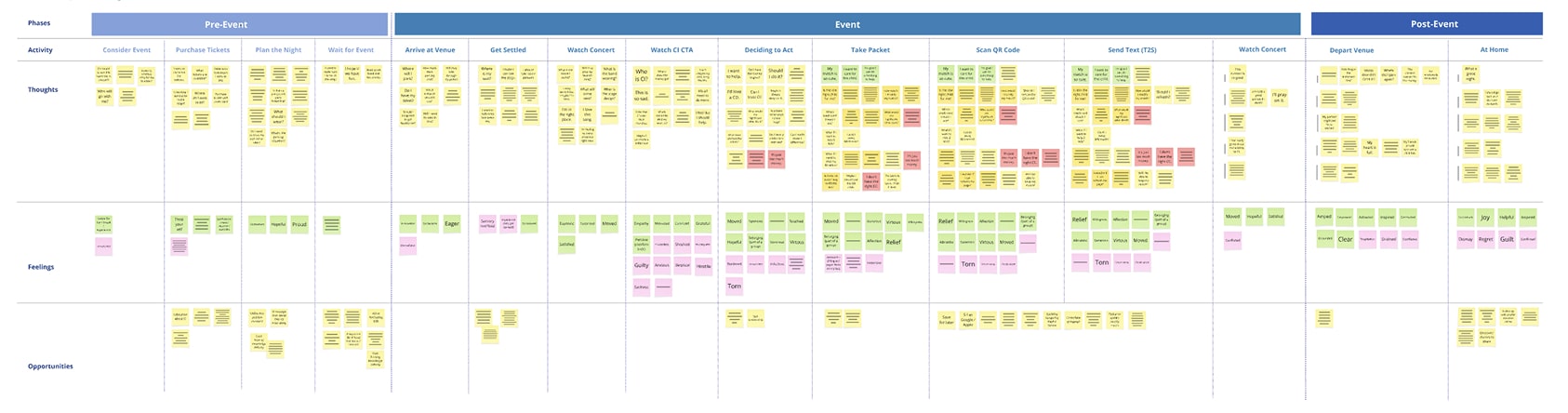
Beyond the monthly financial commitment, we uncovered several additional barriers:
- Many attendees didn’t know enough about Compassion or the sponsorship model to feel confident making such a significant decision.
- Local needs often felt more “real” or urgent than global poverty.
- Some had already committed to other charities and felt tapped out.
- Others felt overwhelmed by the scale of poverty and questioned whether their contribution would make a meaningful impact.
- And for some, the lack of access to digital payment options created a practical hurdle at the moment of decision.
To make it stick, the experience needed to be more than the transaction
Connecting with attendees on an emotional level during the event was valuable, but Compassion was missing a key opportunity to introduce themselves earlier as a trusted partner. To bridge that gap, we created a pre-event email strategy designed to prime supporters—offering education, setting expectations, and introducing an event-specific sponsorship goal to build buy-in and social media engagement. That goal could then be reinforced onstage by the artist, many of whom were eager to champion the cause and track the event’s impact.
While shaping the drip email campaign, we drew on principles from cognitive science to make the messages more helpful and easier to absorb. We introduced key ideas gradually, timed them thoughtfully, and highlighted what other attendees typically found meaningful
Priming
When we are exposed to one stimulus, it can subtly shape how we respond to something that comes afterward—often without them realizing it. These triggers can be everyday words, images, or experiences. Why? In long-term memory, information is stored in clusters called schemas. A sight, sound, or smell can trigger one of these clusters, allowing related memories to come forward.
Lag Effect
We remember things more effectively when the repetitions are spaced out over time. Why? One possible reason: The more varied our encounters with information, the more likely we are to store and interpret it in new ways. Because each repetition forms a slightly different mental imprint, we have multiple pathways for recalling it later.
Social Norms
There are shared expectations about how people should behave in particular situations. They can be as specific as greeting someone with a handshake, or as broad as the unwritten rules that shape how we interpret the actions of others. Why? One of the strongest drivers of human behavior is our need to belong—a trait shaped by our ancestors, who relied on close-knit groups for survival.
We had to make checkout easy
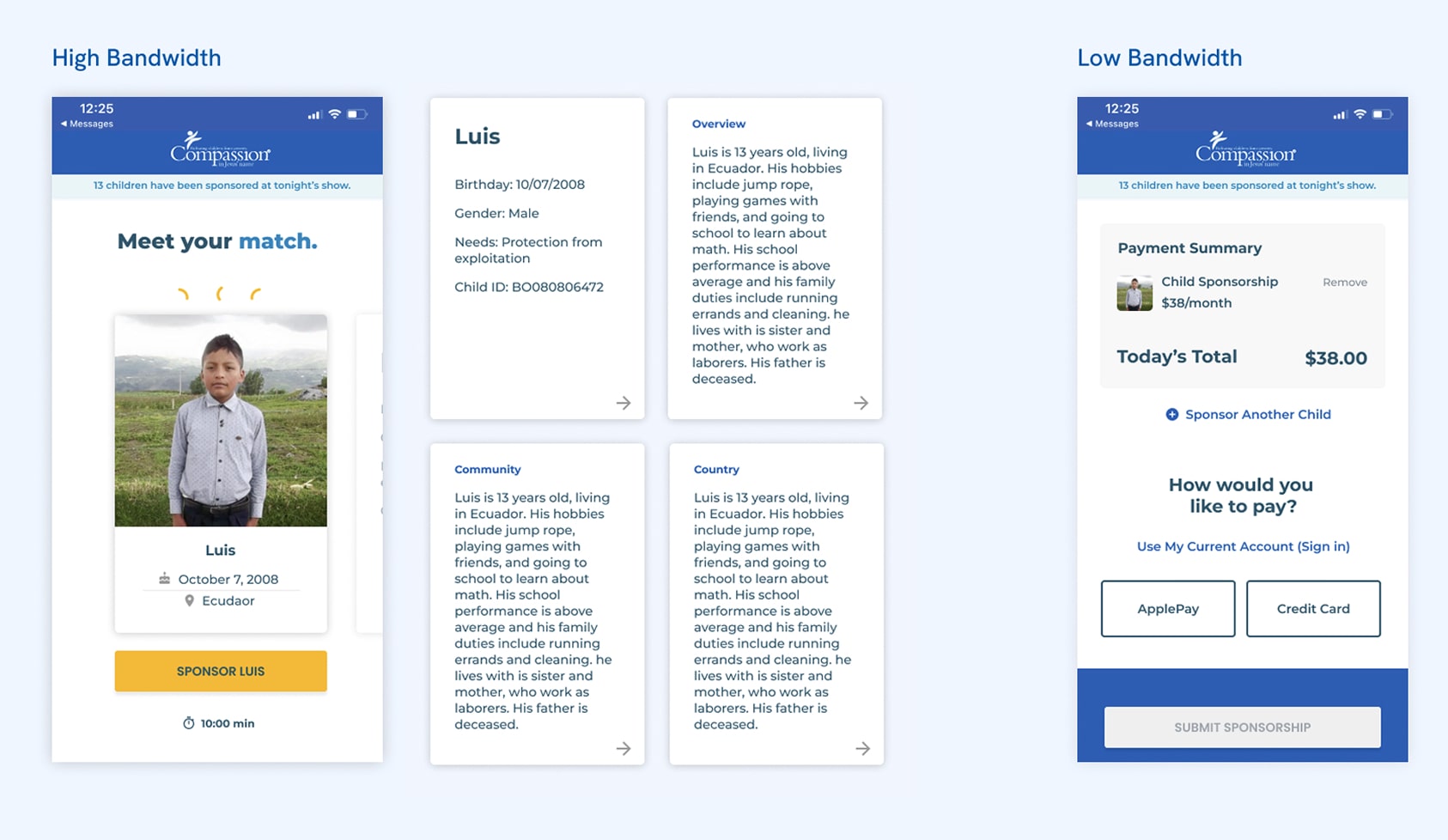
Many Compassion events take place in churches or community venues with little to no cell service—and sometimes no Wi-Fi at all. That meant every element of the mobile experience had to be designed with low-connectivity in mind, optimizing load times and ensuring the app wouldn’t slow down or stall on someone’s device.
The call to action was often made at intermission. It was emotional and moving, but left little time to make a decision when concert-goers were also considering strategic trips to the bathroom, concessions, and merchandise booth; another reason the experience had to be as minimal as possible.
However, this actually worked in our favor — previous research indicated most donors felt overwhelmed when choosing a specific child and preferred to be matched based on certain factors or important causes. Our observations at live events showed attendees proved to be even less selective.

An “Aha” moment: Once concert-goers made up their mind to sponsor a child, most didn’t care about their age, gender, or location. They were just moved to help.
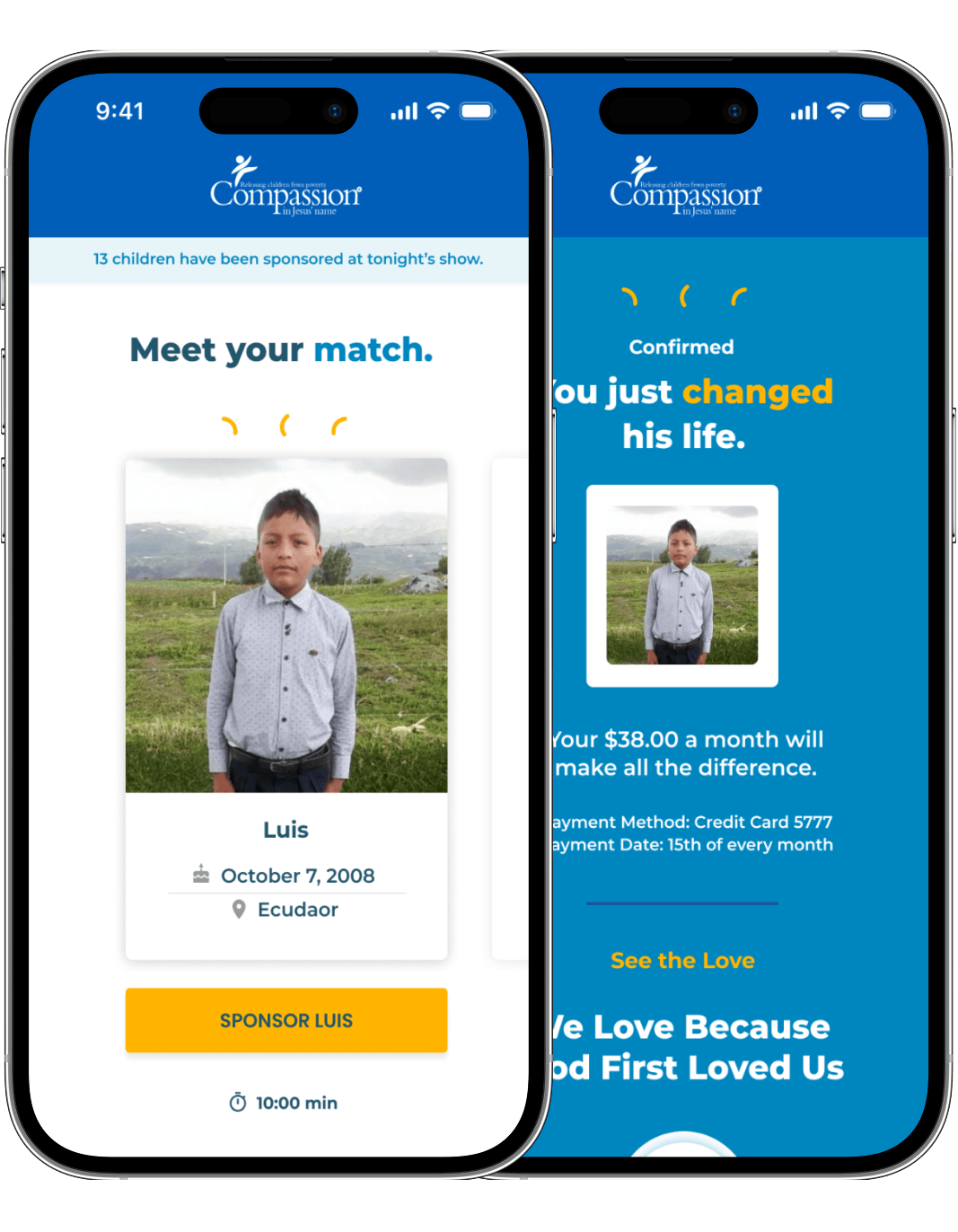
The checkout process couldn’t feel transactional, like purchasing a product. To counter that, we ensured sponsors were greeted with a child’s photo, name, and birthday—keeping the experience personal and centered on real human connection — and given the ability to learn more about the child if they wanted. Even on the low-bandwidth version, a small thumbnail of the child was visible.
We had to reinforce the good decision
With paper sponsorship forms, attendees typically left with a photo from the front of the form and a band CD, often waiting for follow-up information. We wanted to reinforce the sponsorship decision immediately, so we made several key suggestions:
Emphasize impact on the confirmation screen, with messaging like “You just changed his life” to make the effect of the decision tangible.
Display the total number of children sponsored on the tour to show collective impact, on individual confirmation screens and to the larger audience to encourage others to join.
Ask attendees to engage on social media and share their experience; again, using suggestibility and social norms in our favor.
Provide opportunities for further learning and education about Compassion’s work and their sponsored child for after the event.
Include a physical moment at the table where attendees could claim their sponsored child.
Offer a photo of the child that felt personal—something you’d proudly display on your fridge—rather than a standard advertisement.
Follow-up with emails regarding the tour sponsorship goals.
The Impact
Compassion had the highest digital response ever
By better understanding a sponsor’s journey, we were able to streamline the digital experience and find ways to provide educational opportunities to instill trust and credibility. After the updates were released, Compassion had its highest QR code response ever — 85% of tour sponsorships were completed on a mobile device.
“In total the tour had close to 6,000 sponsorships and 85% of those came in via QR code—the relationship managers are attributing a significant portion of that to what you developed.”
Read full review Paul Haddix Product Marketing Manager


