
The Challenge
Serve more people in need
Feeding America is the nation’s largest hunger-relief network, connecting 200 food banks and 60,000 agencies to serve more than 40 million people nationwide. It has significant reach, vision, and influence, operating at the highest levels of policy and industry. Despite being one of the largest nonprofit systems in the U.S. and globally, its on-the-ground delivery depends heavily on volunteers and local agencies—many of them decades old and unable to meet the growing demand for help.
Determined to find a way, Feeding America partnered with us and See What I Mean Consulting to uncover what was limiting the service capacity and develop a strategy to increase the amount of food flowing though these agencies.
More than 44 million people in the United States face hunger, including 1 in 5 children.
Source: USDA’s annual Household Food Insecurity in the United States report
The Work
Here’s how we helped Feeding America
Key activities:
Visited eight food banks and 45 agencies of various sizes
Distributed a national survey, returned by 354 agencies
Conducted over 50 hours of interviews
Created personas of hunger relief agencies and food banks
Uncovered key factors that limit food distribution
Provided nearly 60 pages of insights and recommendations
Created shared tools and language to strengthen collaboration
This was a unique problem for Visual Logic — there was no digital solution or expectation of one. We spent much of our time listening to people in the field and synthesizing what we heard.
Questions we set out to answer
- What is the willingness and capacity of Agencies to grow?
- What is a useful model for growth and how can the Agencies use such a model?
- What more can Food Banks and Feeding America do to build a stronger network for the future?
- How can Food Banks and their partner Agencies prepare to handle and distribute more fresh food
- How can Food Banks and their Agencies help their clients to get all the benefits for which they qualify, especially SNAP?
Understanding agencies through personas
The majority of the food banks and agencies were willing to make the changes needed to do more, distribute more, handle more if it would close the hunger gap in their communities. But we found that every agency has a different history, internal culture, and style.
To better understand and empathize with these differences, we developed personas capturing how Agencies view their work, their relationships with Food Banks, and their connection to the Feeding America Network. Unlike simple lists of tasks, demographics, or market segments, personas offer a snapshot of goals, behaviors, motivations, and a brief narrative of daily workflows. This approach provided insight into an Agency’s way of thinking, not just its structure or size.
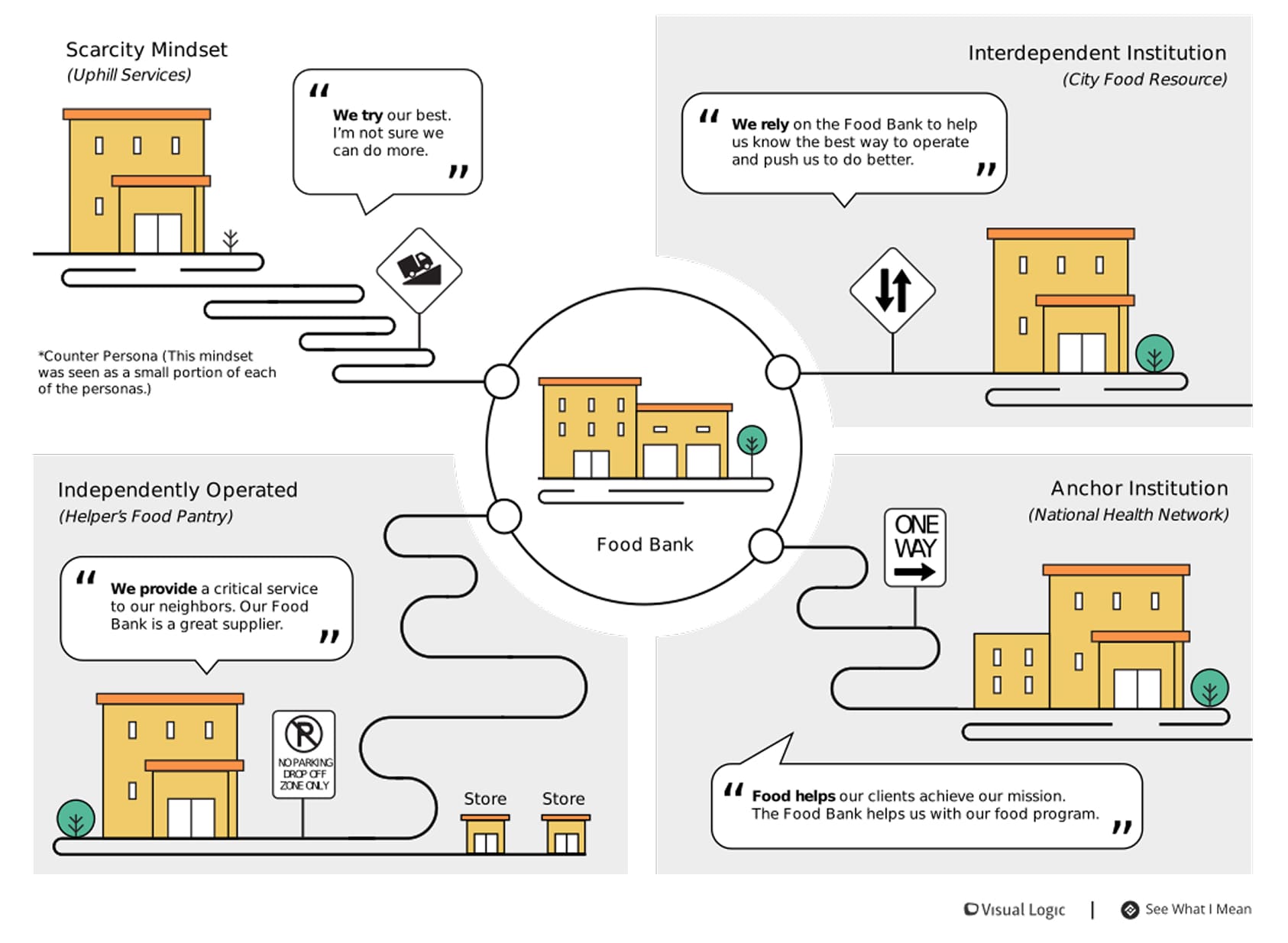
These personas indicated the path forward was not one-size-fits-all for these agencies, like Feeding America had previously thought. We found approximately 25% of the agencies could grow capacity with minimal changes, 50% would need to add or change things in their structure, and 25% didn’t think it was possible.
“We can’t impose our will on a system. We can listen to what the system tells us, and discover how its properties and our values can work together to bring forth something much better.”
Donella H. Meadows Thinking in Systems: A Primer
Crafting a narrative people could rally behind
Once we understood the landscape, it became clear that forcing every agency to meet a single standard was neither feasible nor practical. Feeding America could reach more people by leaning into the unique strengths of its agencies, rather than measuring them against uniform expectations.
The people of Feeding America already shared an unwavering commitment to service—the will was never in question. The real challenge lay in creating clear, effective communication between agencies and food banks, so that shared passion could become coordinated action and move the organization forward together.
Workshopping ways to build a more unified food distribution network
The “Better Together” workshops brought representatives from across the food distribution network together to reimagine how they could better serve their communities. For the first time, agencies were invited into the conversation as collaborators, rather than being informed after decisions were made. We shifted the dialogue from “Why aren’t you meeting our standard?” to a more empowering question: “What’s the best you can do?”
The three objectives we outlined may seem simple, but they were essential in ensuring everyone felt seen, heard, and valued.
The way we work together
- Build a system that strengthens network capacity through co-leadership
- Streamline compliance and create new pathways for growth and development
- Expand access, choice, and individualized options for every community
The way we decide together
- Make decisions that center what’s best for every person facing hunger
- Adopt a shared network mindset rooted in equity and collaboration
- Ensure every voice is seen, heard, and valued in decision-making
The way we treat each other
- Strengthen relationships and trust across the network
- Embrace a unified mindset that fosters respect, empathy, and partnership
- Ensure equity so all people—and all network members—are seen, heard, and supported
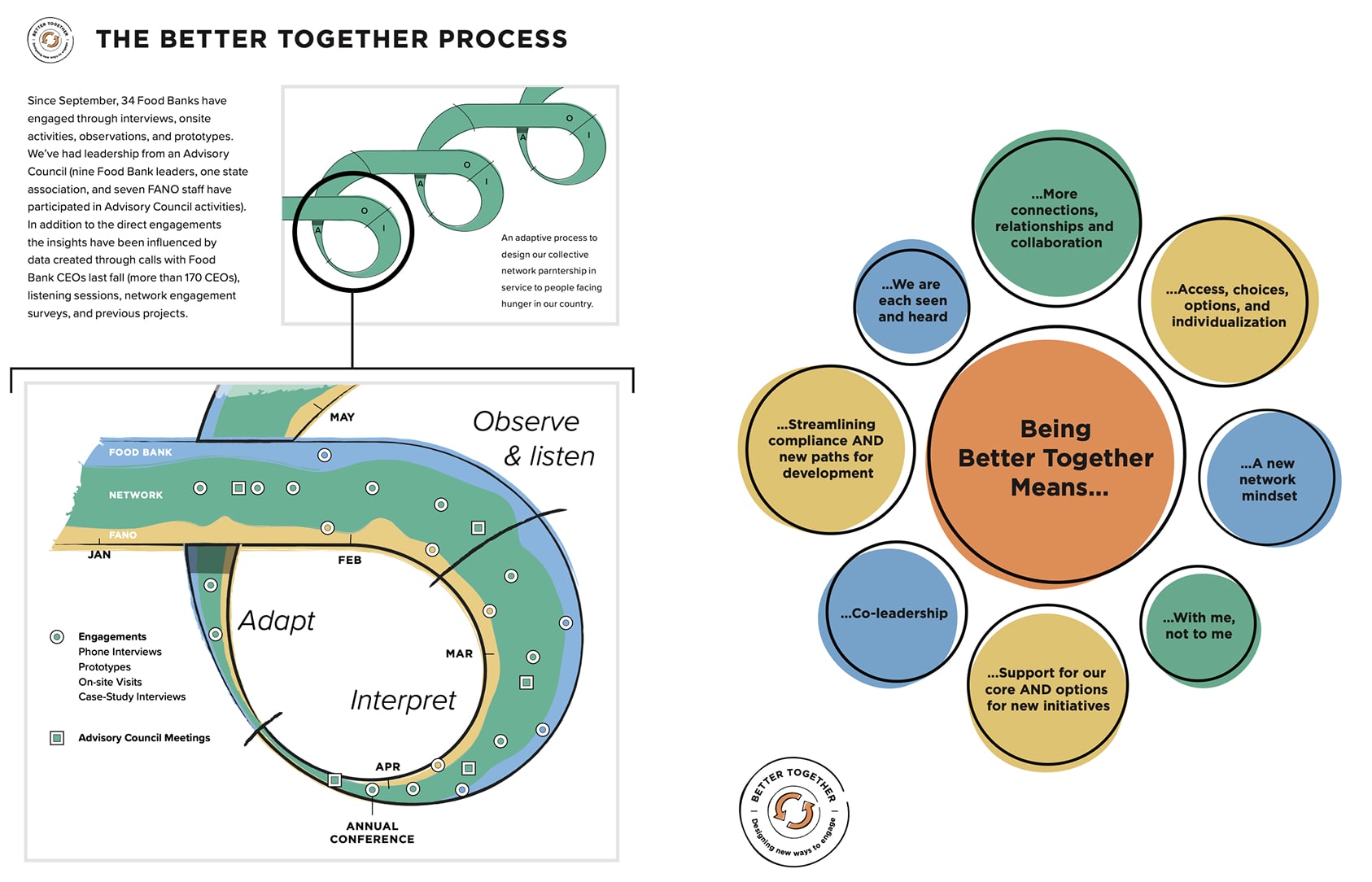

The workshop gave participants a new way of thinking about the problem space, while generating practical ideas to expand service capacity and increase participation across the network. It also helped agencies identify the single critical factor that could unlock greater involvement—often something as simple as a refrigerator. What felt trivial to Feeding America could be transformative for a small agency.
The sessions surfaced opportunities that many agencies didn’t realize were within reach, such as partnerships already negotiated by Feeding America. Too often, these agencies missed out because they felt excluded from conversations or overwhelmed by complex requirements. In some cases, agencies couldn’t participate at all due to basic constraints—like lacking cold storage—but those barriers remained invisible because no one had engaged them directly or taken their challenges seriously.
The Impact
A new mindset to motivate growth
This strategic plan gave Feeding America a clear path to turn collective research into meaningful action. We equipped food banks with self-guided tools to identify the agencies within their networks by distinct personas, and to develop targeted plans for increasing food distribution through each one.
Our research showed that many agencies don’t want to fit a standard mold, don’t plan to, or simply can’t. Rather than overlooking them, our plan offered guidance on how to engage and leverage their unique capabilities. By activating more of the network in ways that reflect its diversity, food banks can move more food overall.
Just as importantly, the plan established a shared language that improved communication between food banks and agencies, helping agencies clearly demonstrate their value. In doing so, we amplified the voices of those who had previously felt invisible—because we are all better together.