
The Most Dangerous Moment in Any Defense Program
It’s not the system failure. It’s not the budget cut.
It’s the moment someone says: “Let’s just modernize the interface.”
We’ve seen what happens next. The team inherits 40 years of accumulated assumptions. The requirements document becomes the design document. And the operator — the person whose life depends on making the right decision in three seconds — gets a faster version of the same broken experience.
That’s not a technology problem. It’s a thinking problem.
What We Did Differently on Patriot
When Visual Logic was brought in to redesign the Patriot Warfighter Machine Interface (WMI), we were handed something rare: permission for deep design thinking before we built anything.
Our RTX sponsor made it explicit. While we were learning missile defense doctrine, mission theory, and operator reality, we would be shielded from the existing system requirements. Not because requirements don’t matter. They do. But introducing them too early puts the focus on the system, rather than the user, and the technology turns out to be unusable. Often, it lacks Human-Centered Design (HCD), or it’s considered way too late in the process.
What it normally looks like: Engineering-led from the early strategy stage. The user experience is often an afterthought; everything feels milestone driven, often missing a unified vision and experience goals.

We lead with a different approach. RTX embraced it.
We prioritized the time for design thinking before considering detailed technical solutions. This process helped us imagine the way a warfighter should experience their mission space and environments first, then we designed and built a system that felt natural in their domain.
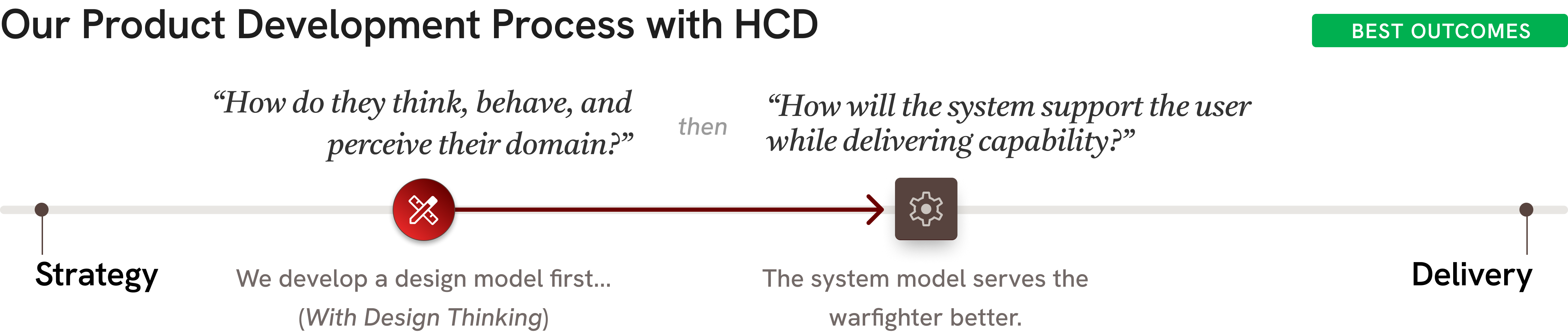
We studied decision-making under stress. We mapped the cognitive load of an operator managing a threat environment in real time. We spent significant time with SME’s who helped us learn the system, as if we were actual operators. We dialogued at length, with system engineers about what was possible for the future. We pushed each other to think critically about the optimal warfighter experience.
That effort narrowed us towards three fundamental warfighter questions that seemed obvious, but needed to be fully reconsidered after 40 years:
How will I fight?
What is my unit’s posture, and how does that shape my response to a threat?
Can I fight?
What capabilities do I have available right now?
What is the fight?
What is actually happening in the threat environment, and what does it demand of me?
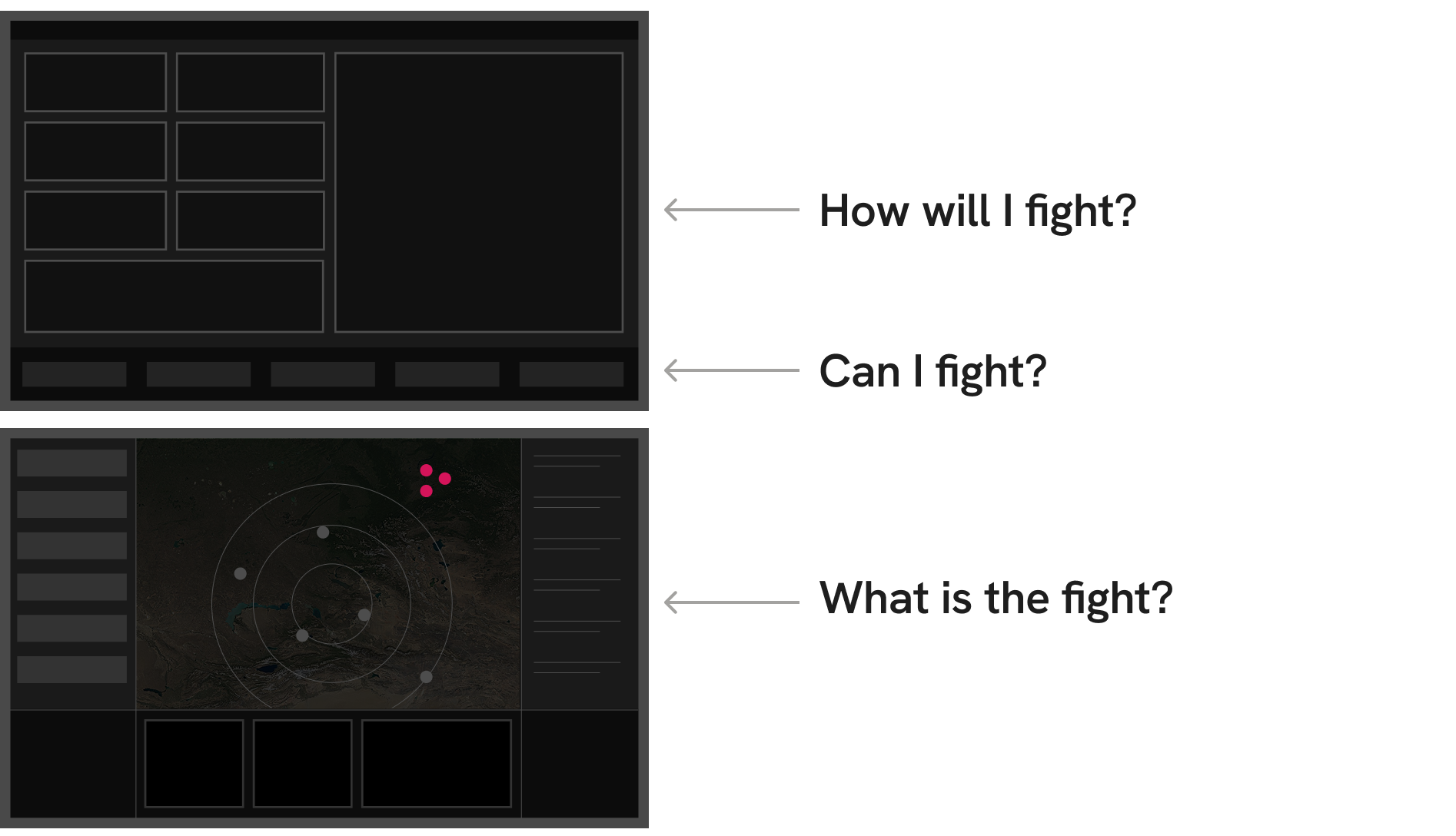
Those questions became the driving design tenets. Every screen, every workflow, every interaction was built to answer one of them — quickly, clearly, under pressure.
The results were not incremental. Training times dropped. Task completion rates exceeded expectations. Operators who had spent years navigating the old system described the new interface as something that finally made sense.
Making time for design thinking created the vision, which then enabled the detailed design to move faster. Driven by real insights, and with broad team buy-in.
The Principle Behind the Project
Every defense system that touches a human operator has a moment of truth: the moment that operator has to act, and the interface either supports them or fights them.
Most interface development never seriously interrogates that moment. It inherits assumptions, modernizes the aesthetics, and ships.
Human-centered design starts from a different place entirely. It asks;
- What does the operator actually need to know?
- In what sequence?
- Under what conditions?
- With what consequences for error?
It builds the foundational information architecture around those answers. And it uses technical constraints to refine a solution, not to define one.
That end experience feels fundamentally different for the warfighter.
We’ll use this basic scenario of an air defense system detecting a potential threat that to compare the outcomes of those processes:
| HIGH RISK The Common Approach | BEST OUTCOMES Our HCD Approach | |
|---|---|---|
| Threat Detection | What’s happening: Alerts pour in, often organized by system architecture, and the operator must interpret engineering language and non-distinct visual hierarchy. How it feels:Chaotic and over stimulated. Struggle to know what to focus on first. | What’s happening: The system immediately provides contextual alerts that match warfighter expectations based on the severity of the situation and prioritized accordingly. How it feels:Unambiguous voice paired with clear CTAs. “It’s speaking my language.” |
| Threat Classification | What’s happening: All sensors are contributing dense, raw data onto the GUI. The operator is sifting through, trying to pull together the most critical pieces. How it feels:Panicked and pressured—we need to make a decision. “Did I assess all the right info?” | What’s happening: System surfaces relevant data only, simplifying the interface to maximize focus on the classification process and necessary communication. How it feels:There’s no “scramble,” cognitive load minimized. “The right information came to me.” |
| Select Engagement Type | What’s happening: The system offers manual selections, and the operator is recalling on training, peers, and command, what the protocols say, and more... How it feels:The operator is hunting for knowledge and affirmation around their decision—wrangling the system into the right engagement state. | What’s happening: The system makes a recommendation based on threat + capabilities + TTP, with supporting confidence metrics and clear affordances for modifications. How it feels:Operators feels partnered with the system. “I understand why it’s guiding me this way.” |
| Authorize & Fire | What’s happening: The system relies on the operator to understand where and how to initiate. How it feels:The system was waiting on me, extra steps and thinking after an already tedious process. “I hope I got this right.” | What’s happening: Cues and options are clear and match urgency, guiding towards a safe, confident action How it feels:The system feels proactive, trust was earned, decision confidence is high, and they’re ready for the next threat. |
The design approach you use will have a massive impact on mission and warfighter success.
- HCD finds a way to deliver needed capabilities in the warfighters language. Clear, intuitive, and actionable.
- Traditional design approaches often surface those same warfighter needs in the system language. Technical, dense, and fragmented.
That discipline is harder to schedule, and even harder to explain to a program office. But, the evidence is consistent: systems built this way perform better, train faster, and hold up under the pressure they were designed for.
There were faster ways to do it, but in my opinion, no better way to do it.
Nate Jones Senior Director of Patriot Programs at RTX, Retired Army Chief Warrant Officer (CW5) & Former Head of Patriot Top Gun School
Why This Matters Now
The defense programs being funded today like IBCS, next-generation C2, and AI-augmented ISR are more complex, faster, and higher-stakes than anything that came before. The operator burden is growing, and the margin for interface failure is shrinking.
If your program has a human in the loop, the quality of that interface is a mission-critical variable. Not a UX consideration. Not a Phase 3 deliverable.
User experience is a mission-critical variable.
We’ve spent over 20 years solving exactly this problem across the systems that shape how warfighters see, decide, and act. From the highest levels of strategy and wargaming, down to the critical wearables that keep the front lines safe, we take the complexity seriously and tackle it head-on.
If that work is relevant to what your team is building, we’d welcome the conversation.