The Department of Defense formally adopted the standard for Human Readiness Levels (HRL) to improve software.
Aligning TRL with HRL
Advancing human readiness levels in complex systems
Technology + Human Readiness = Mission Success
Human Readiness Levels (HRL) are a framework used to evaluate whether complex systems are ready for the people who must operate them. While engineering teams track technical maturity with Technology Readiness Levels (TRL), HRL focuses on human performance, usability, and mission effectiveness.
Technology Readiness Level (TRL)
Helps us define how mature the technology is (how useful is it?). This is where you excel.
+
Human Readiness Level (HRL)
Adopted by Pentagon - Aug 2025Helps us understand how well a human can utilize the technology (how usable is it?). This is where we excel.
HRL bridges the gap between
military technology and humans
It’s used to guide, track, and communicate the design maturity with respect to its usability and safety.
This new scale will help enhance decision-making, situational awareness, and operational efficiency for all warfighters.
“Have we designed a product or system a warfighter is actually capable of using in the field?”
Mission-ready software needs high TRL and HRL
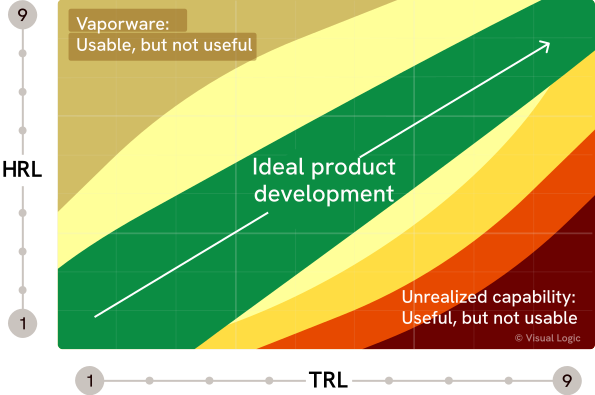
Balancing TRL with HRL is key
Solutions that move too far in their technology readiness without fully accounting for user needs and human interaction run the risk of delivering sophisticated tech that’s useful, but not usable. Similarly, focusing too heavily on innovative concepts first can produce ideas that go beyond technical feasibility — they may be usable, but it’s just vaporware.
Model adapted from ANSI/HFES 400-2021.
HRL unlocks value: Improve human performance while reducing operational costs
Reduce Human Error
Up to 90% of accidents in complex systems are attributed to human error. UX and engineering can remove error opportunities before the warfighter ever interacts with the system.
Faster Training Time
While some systems are considerably complex, understanding human behaviors positions the team to create familiar patterns and frameworks that improve ease of use and learnability.
Lower Lifecycle Cost
Operations and support account for more than 60% of a major system's total cost. Fixing usability issues during design is significantly cheaper than retraining thousands of soldiers or retrofitting fielded hardware.
Visual Logic helps make your product human ready,
so our warfighters can be battle ready
Our Human-Centered process guides you from HRL 1 to HRL 9.

Research & Requirements

Our emphasis on empathy allows us to document the emotional and behavioral drivers of users, which is essential for defining the human capabilities and limitations.
We use a suite of research methods that keep both the user and the business needs in focus while we progress with early concepts and solutions. The outcomes and artifacts from this stage help us generate early concepts, strong information architecture, use cases, and user needs, which in turn helps to bolster existing requirements, and establish new ones that best reflect the collective Voice of the Customer.

Modeling, Prototyping, & UX Design

Our iterative approach to design starts with translating synthesized research into more refined concepts that can be validated with real users, the customer, and the business. While the sine wave of change is still broad and exploratory, scenario and task-based evaluations iteratively advance the fidelity of ideas, and with that, the value of the solution. Towards the end of this phase (HRL 6), the workflows and design on the human interactions should be “done”—and the sine wave of change is minimal with only critical design tweaks.
As we move through these stages the team will be collecting metrics and other data that will demonstrate human readiness relative to program goals, and act as the baseline for future product enhancements.
Note: HRL 4-6 represents the majority of what most consider traditional design, moving from many concepts down to one validated solution.

Usability Testing & Enhancements
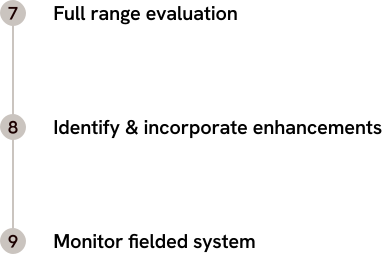
While concept validation and usability evaluations start at the earliest stages of research and design, this phase allows us to test the full breadth of a system (especially in complex or large systems of systems) in a lifelike environment—”stringing it all together.”
If we’ve executed the previous phases with craft and rigor, we should be identifying only small, non-critical adjustments needed to the interfaces at this point.
Note: To meet HRL 9, you must do comprehensive usability evaluations in an operational environment. Once the product or system is fielded, experts continue to evaluate to ensure the system operates as expected over time and through various unforeseen use cases.
A partnership with engineering from start to finish
Visual Logic designers are deeply embedded with our client’s engineers, collaborating on key product decisions and bringing the user’s lens to the solution.
The HCD process informs engineers with clarifying research artifacts that bolster requirements and influence design.
We use our background in understanding human behavior to drive interaction design, then evaluate the user experience to provide prioritized iterations.
Note: Visual Logic does not provide traditional engineering roles—you’re the experts there—we partner to bring the user’s perspective and great user experience to your brilliant technology.

Not every path to a higher HRL
will look the same.
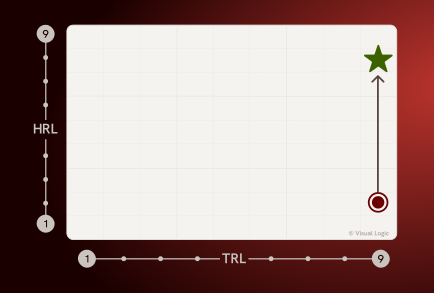

Proven TRL 9, but Apollo era HMI
Raytheon’s Patriot defense system has protected the skies for decades, but the interface soldiers used to operate the system didn’t meet modern standards and patterns for human interaction. We retrofitted their proven technology with interactions an operator would expect from today’s products.
Read the case study


Advancing together
Exergi’s energy management and prediction technology plays a critical role in mission planning, and increases successful outcomes across challenging route logistics. They came to Visual Logic with a technical concept in the early TRL stages, then worked with us to mature their sophisticated energy prediction models while making it usable and interpretable from command to execution.
Read the case study

Humans first, technology second
Developing sophisticated technology can be costly. Sometimes you need to make a compelling case—to cast a vision for the future—to achieve the buy-in needed to fund the next stage of development. By maturing the HRL beyond the TRL, we crystallized the endgame product vision, giving the team a clear rallying point and garnering support from key stakeholders.
Case study coming soon
Ready to operationalize HRL in your program?
Human Readiness Level (HRL) may be new, but Visual Logic has been delivering human-ready defense systems for nearly two decades. We are experts in Human-Centered Design for mission-critical defense systems.